The trapezoid envelope
Attack, On, Decay, Off. Four phases, all of them times. The shape the VCS3 drew in 1969, why it feels nothing like ADSR, and why it's the LFO on two of our synths.
First, the shape everyone knows
An envelope is a control signal that rises and falls when you play a note. The familiar one is ADSR: Attack (how long to rise), Decay (how long to fall to the sustain level), Sustain (a level, held for as long as your finger is down) and Release (how long to fade once you let go). Three times and a level, and the note's length is decided by you.
Then the trapezoid
The envelope shaper on the EMS VCS3 did it differently. Its four controls were Attack, On, Decay and Off. Rise for the attack time, hold at the top for the on time, fall for the decay time, wait at the bottom for the off time. Draw that and you get a trapezoid.
Two things change everything.
- On is a time, not a level. The note has its own length, set on the panel. Tap a key and you get the whole shape; hold it and you still get the whole shape. The envelope has rhythm built in.
- Off is a time too. Set it to a finite value and, when it runs out, the envelope fires itself again. A trapezoid with a short Off time is a loop. A loop is an LFO, with a shape you drew rather than a waveform you chose.
That second point is why the VCS3 could pulse, throb and breathe with no LFO patched anywhere, and why we love the trapezoid envelopes of a VCS3. That sound recalls an era without boundaries.
What we did with it
Six modes, one of them this
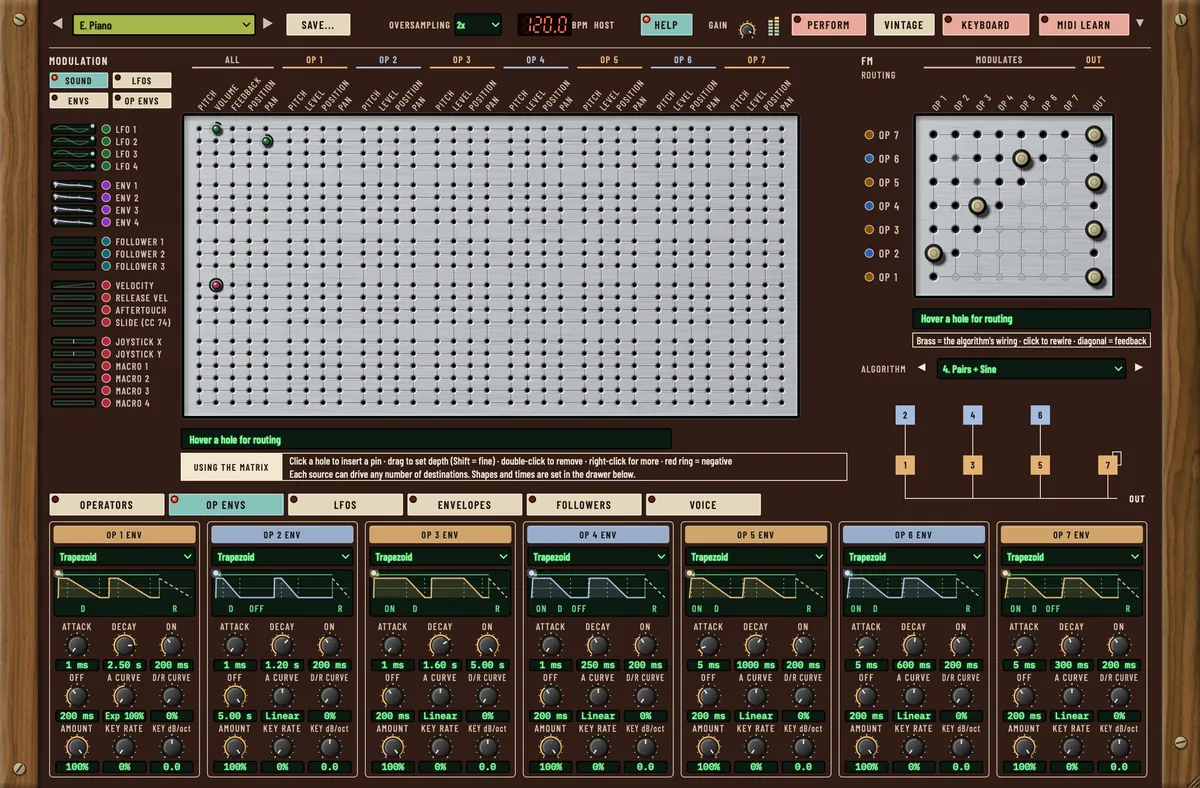
Every modulation envelope on a Silicon Antiques synth can be switched between six modes. The last one is the trapezoid.
| AD | Rise, fall. Percussive. |
|---|---|
| ASR | Rise, hold while the key is down, fall. |
| ADSR | The familiar one. |
| AHDSR | ADSR with a timed hold at the top before the decay. |
| DADSR | ADSR with a delay before anything happens. |
| Trapezoid | Attack, On, Decay, Off. All times. Loops when Off runs out. |
Every phase, synced to tempo
Each stage of each shape can lock to a multiple or division of your song's clock, independently. An attack of one beat, an On of a bar, a decay of a sixteenth, an Off of three beats: an envelope that is a rhythm, not just a contour. Analog shapers had knobs; ours have clocks.
The LFO you can draw
Tant and Tonnau have no LFOs by name. They don't need them. Set an envelope to Trapezoid, set its trigger to Free rather than Key, and it loops forever, in time with the track if you've synced the phases. Tant defaults all four envelopes to trapezoids. Tonnau's envelopes 2, 3 and 4 start life as looping trapezoids. Mellt, the FM synth, keeps eleven conventional LFOs alongside its trapezoids, because FM likes a sine.
Three ways in
- Rhythmic filter. Trapezoid, Free trigger, On = one eighth, Off = one eighth, pinned to Cutoff. A square-wave filter pulse locked to the grid.
- Slow tide. Attack = two bars, On = one bar, Decay = two bars, Off = one bar, pinned to wavetable Position on Tonnau. A seven-bar breath.
- Plucks that aren't. On Tant, a key-triggered trapezoid with a long On pinned to Brightness turns a pluck into a bowed swell, then back.
Draw one.
Trapezoid envelopes with tempo-synced phases are on all three Silicon Antiques synths, free for macOS as AU, VST3 and Standalone.